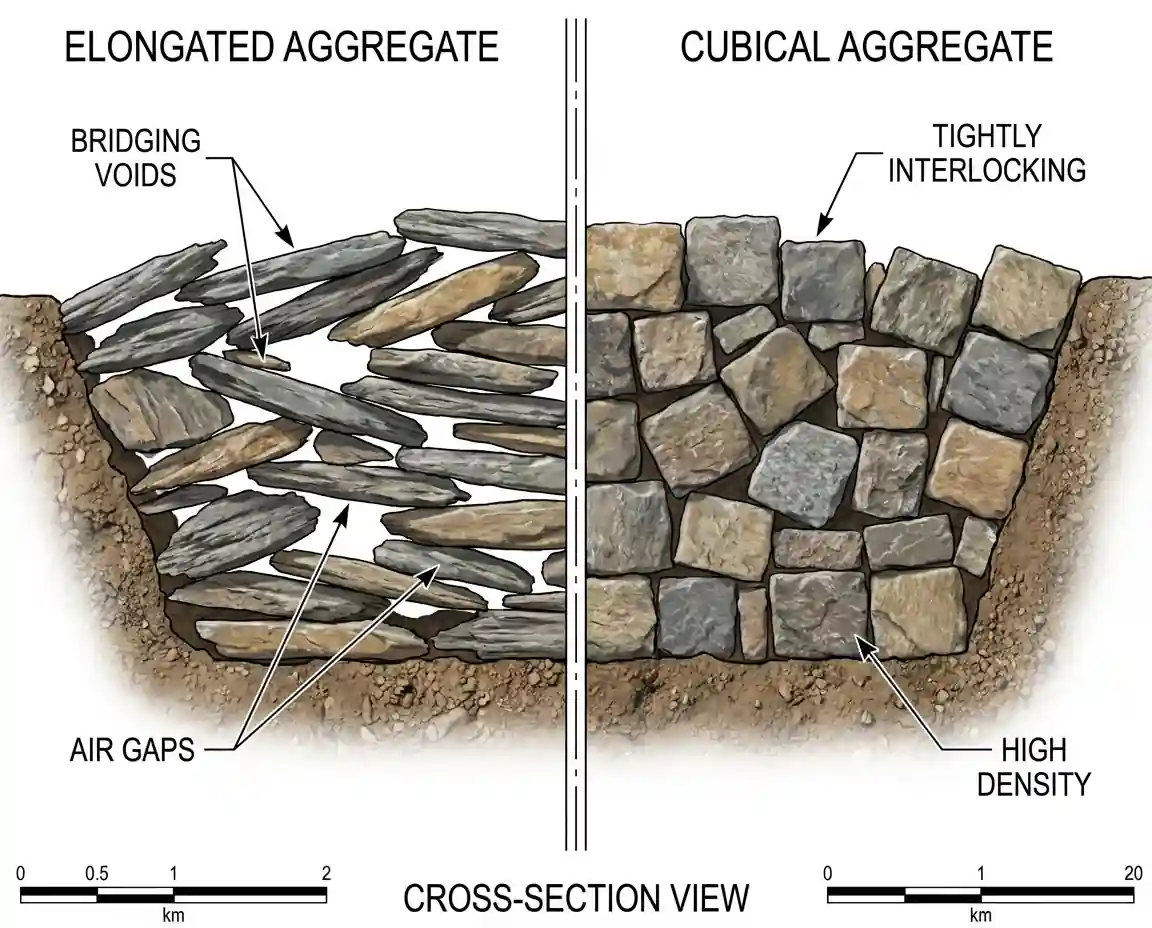
In civil engineering, “compaction” is often simplified to a measure of density—how much mass can we pack into a cubic meter? But density is a byproduct, not the mechanism. The real mechanism driving load-bearing capacity in unbound road base is internal friction, or the ability of particles to interlock under stress.
This is where the geometry of your aggregate—specifically its cubicity—becomes the single most critical factor in pavement longevity.
The Flakiness Problem: Jaw Crusher Limitations
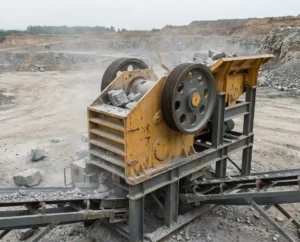
Traditional compression crushing (Jaw and Cone crushers) relies on squeezing rock until it fractures. While effective for reduction, this often exploits the rock’s natural cleavage planes, resulting in high elongation ratios.
According to ASTM D4791 (Standard Test Method for Flat Particles), these “flaky” particles present two major structural failures during compaction:
- Bridging: Elongated particles tend to bridge over voids rather than filling them. Under dynamic loading (traffic), these bridges snap, causing immediate settlement and rutting.
- Planar Slippage: Flat particles tend to orient horizontally. Like a deck of cards, they slide easily over one another. They lack the multi-directional friction needed to resist lateral shoving.
The VSI Solution: Rock-on-Rock Mechanics
To achieve superior shear strength, modern specifications are increasingly favoring aggregate produced via Vertical Shaft Impactors (VSI).
VSI crushers operate on a different principle: high-velocity impact. By accelerating stone against a bed of other stone (a process known as autogenous crushing, the material doesn’t just break; it shatters along natural fissures. This process naturally eliminates weak, flaky edges, leaving behind a highly cubical core.
Why Cubes Carry More Weight
A cubical particle acts like a puzzle piece. It has multiple faces available for contact, significantly increasing the angle of internal friction.
- Better Load Transfer: Vertical loads are distributed outward (radially) more effectively, reducing point-loading on the subgrade. Recent studies on aggregate and void characteristics confirm that uniform aggregate distributions enhance this interparticle interlocking, directly increasing shear resistance.
- Reduced Binder Usage: In asphalt applications, cubical aggregate has a lower surface-area-to-volume ratio than flaky aggregate. This means less bitumen is required to coat the stone, improving the strength-to-cost ratio of the mix.
For the site superintendent, the difference is felt immediately in the seat of the pants. Cubical aggregate “locks up” tighter and faster under the roller, requiring fewer passes to hit proctor density.